While most people have dealt with a painful sore at some point, it is vital to understand the early signs of Mouth Cancer. This condition often begins as a small spot, but unlike a common ulcer, Mouth Cancer requires immediate medical attention for successful treatment. Recognizing the persistent nature of Mouth Cancer can literally save your life.
Most mouth ulcers are completely harmless and heal on their own within one to two weeks. However, some sores in the mouth can be a sign of something more serious. Knowing the difference between a normal ulcer and malignancy is the first step toward effective prevention.
Dr. MSS Keerthi, a leading Cancer Specialist at Hills Gastro & Onco Care with over 17 years of experience, sees many patients who delay seeking help because they assumed their sore was just a regular ulcer. Early detection makes a huge difference in treatment outcomes. If you have a mouth sore that is not going away, this guide will help you understand when it is time to consult an expert Cancer Surgeon.
What Is a Normal Mouth Ulcer?
A normal mouth ulcer — also called an aphthous ulcer — is a small, shallow sore that appears inside the mouth. It can show up on the inner cheeks, tongue, gums, or lips.
Common causes of normal mouth ulcers include:
- Minor injury from biting your cheek or tongue
- Hot food or drinks burning the mouth lining
- Stress or lack of sleep
- Nutritional deficiencies (iron, Vitamin B12, folate)
- Hormonal changes
- Spicy or acidic food irritation
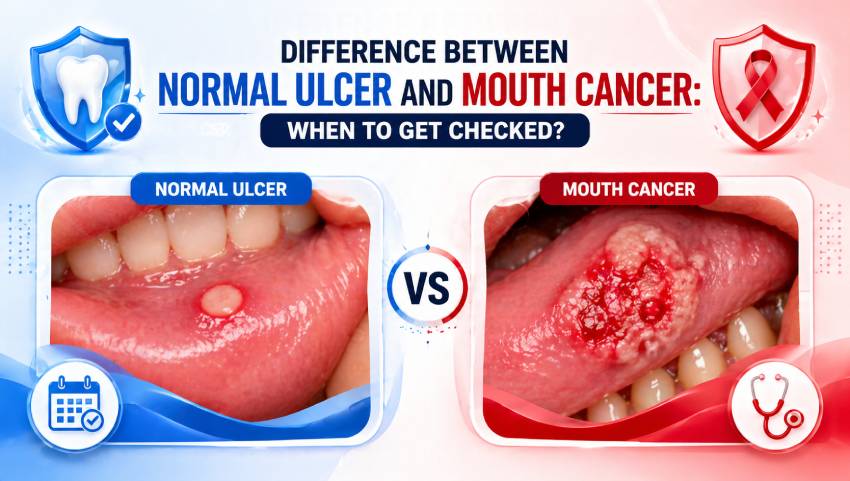
What does a normal ulcer look like?
- Round or oval-shaped
- White or yellow centre with a red border
- Usually 2–8 mm in size
- Painful to touch
- Heals within 7–14 days without treatment
Normal ulcers are not dangerous. They come and go. They hurt, yes — but they heal.
What Is Mouth Cancer?
Mouth cancer, also called oral cancer, is the abnormal and uncontrolled growth of cells in any part of the mouth — including the lips, tongue, cheeks, gums, roof of the mouth, or floor of the mouth.
Oral cancer mouth ulcers look different from regular ulcers. They may start small and painless, which is why many people ignore them. Over time, they can grow, spread, and become life-threatening if not treated early.
Risk factors for mouth cancer include:
- Tobacco use (smoking, chewing, gutka, paan)
- Alcohol consumption
- HPV (Human Papillomavirus) infection
- Long-term sun exposure (especially for lip cancer)
- Poor oral hygiene
- Family history of cancer
Difference Between Normal Ulcer and Mouth Cancer:
| Feature | Normal Mouth Ulcer | Mouth Cancer |
|---|---|---|
| Duration | Heals in 7/14 days | Lasts more than 3 weeks |
| Size | Small (2/8 mm) | Can grow larger over time |
| Pain | Usually painful | Can be painless (especially early stage) |
| Appearance | White/yellow centre with red border | Irregular red or white patch with rough edges |
| Shape | Round or oval | Irregular, uneven edges |
| Bleeding | Rarely bleeds | May bleed without reason |
| Number | Often single or a few | Usually single persistent sore |
| Cause | Known trigger (injury, stress) | No clear cause, appears spontaneously |
| Surface | Smooth and flat | Raised, rough, or hardened |
| Surrounding Tissue | Normal and soft | May feel hard or lumpy underneath |
| Location | Inner cheeks, tongue tip, lips | Tongue sides, floor of mouth, lip |
| Healing | Heals completely | Does not heal or keeps returning |
| Response to Treatment | Improves with gels or vitamins | Does not respond to regular ulcer treatments |
| Associated Symptoms | Soreness only | Difficulty swallowing, ear pain, weight loss |
| Risk Factors | Stress, nutritional deficiency | Tobacco, alcohol, HPV infection |
How to Know If It Is an Ulcer or Cancer?
This is the most important question. Here are the key things to watch for:
Signs it is probably a normal ulcer:
- It appeared after you bit your cheek or ate something hot
- It is small, round, and very painful
- It is healing after a few days
- You have had similar ulcers before
Signs it could be something more serious — like cancerous ulceration:
- The sore has been there for more than 2–3 weeks
- It is a painless ulcer on the lip or tongue
- The sore looks like a mouth cancer white patch or a red patch (mouth sores red)
- The edges feel hard or raised
- It bleeds when you touch it gently
- You also have a lump in your neck
- You are finding it hard to open your mouth fully or swallow food
Remember: A painless sore is NOT a “safe” sore. In oral cancer, painless ulcer on lip or tongue is actually one of the early warning signs.
Dr. MSS Keerthi Recommends The 2-Week Rule:
One of the simplest and most powerful rules in oral health is what Dr. MSS Keerthi calls the 2-Week Rule:
“If any sore, ulcer, or patch inside your mouth has not healed in 2 weeks — get it checked. Do not wait, do not assume. Early detection saves lives.”
This rule applies to:
- Any mouth ulcer that is not healing
- Any red or white patch inside the mouth
- Any lump or swelling in the mouth or jaw
- Any unexplained pain while swallowing
The 2-Week Rule is especially important for people who use tobacco, alcohol, or paan. These habits significantly increase the risk of mouth ulcer cancer developing into a full-blown oral cancer.
At Hills Gastro & Onco Care, this simple rule has helped identify cancer at early stages in many patients — making treatment easier, less intensive, and far more successful.
When Should You Worry About a Mouth Ulcer?
Not every ulcer needs a doctor’s visit. But certain situations should put you on alert immediately.
Worry if you have a mouth ulcer:
- Has not healed after 2–3 weeks despite home care
- Is growing in size over time
- Is painless but persistent (this is a red flag — mouth ulcer cause cancer is often painless in early stages)
- Has hard or raised edges when you feel it with your tongue
- Is bleeding on its own or when you eat
- Is accompanied by a lump in your neck or under your jaw
- Is associated with difficulty opening your mouth or swallowing
- Has a rough, uneven texture unlike normal mouth tissue
Also, worry if:
- You have multiple sores that keep coming back frequently
- You have mouth sores red or white patches that spread
- You smoke, chew tobacco, or drink alcohol regularly
- You have a family history of oral cancer mouth ulcers
In any of these cases, do not self-diagnose. Get a professional evaluation immediately.
When to Consult a Mouth Cancer Specialist?
Many people in India delay visiting a doctor because they are either scared of the diagnosis or they assume it will go away on its own. This delay is dangerous.
You should consult a specialist if:
- Your sore mouth has lasted more than 2 weeks
- You notice a mouth cancer white patch or red patch that is not going away
- You feel a lump or hardness inside your cheek, tongue, or jaw
- You have bleeding from the mouth without any reason
- You experience pain while chewing or swallowing
- You notice loose teeth, jaw pain, or numbness in the mouth
- You use tobacco or alcohol and have any persistent mouth change
Where to go: Hills Gastro & Onco Care, led by Dr. MSS Keerthi, offers expert consultation for Mouth Cancer Treatment and early-stage oral cancer detection. With 17 years of experience, the team provides personalised care, advanced diagnostics, and compassionate support throughout your treatment journey.
Do not let fear hold you back. The earlier you get checked, the better your chances of a full recovery.
Conclusion:
The difference between a harmless ulcer and a life-threatening cancer often comes down to one thing — time. Normal mouth ulcers heal. Cancer does not go away on its own.
Here is a quick summary to remember:
- Normal ulcers heal within 7–14 days
- Cancer sores last more than 2–3 weeks
- A painless sore is not always safe — it can be a sign of cancerous ulceration
- Tobacco, alcohol, and gutka use are major risk factors for oral cancer mouth ulcers
- Always follow the 2-Week Rule — if a sore has not healed in 2 weeks, get it checked
If you or anyone in your family has a sore that is not healing, do not ignore it. Visit a qualified Cancer Specialist at the earliest. Early diagnosis means easier treatment, better recovery, and saved lives.
FAQ's:
Yes, mouth ulcers can sometimes look very similar to early-stage oral cancer. Both can appear as sores inside the mouth. The key difference is that regular ulcers heal within 1–2 weeks, while cancerous sores persist beyond 2–3 weeks, may bleed without cause, and often have irregular, hardened edges. If you are unsure, always get it professionally evaluated. Do not try to self-diagnose.
The 3-finger test is a simple self-check for mouth opening. Normally, a healthy person should be able to fit 3 fingers (stacked vertically) between their upper and lower teeth when the mouth is fully open. If you can fit only 1 or 2 fingers — or less — it may indicate trismus (restricted mouth opening), which can be a sign of oral cancer or pre-cancer. This test is a helpful early warning check, but it should not replace a proper medical examination.
While most mouth ulcers are harmless, some persistent ulcers can indeed be cancerous or precancerous. If an ulcer does not heal within 2–3 weeks, has irregular edges, is painless, bleeds without reason, or grows in size, it must be checked by a specialist immediately. The fact that a sore does not hurt does not make it safe. Painless ulcers are actually more concerning in some cases.
Bleeding from the mouth can have many causes — gum disease, injury, or mouth ulcers. However, unexplained bleeding that occurs repeatedly, without any clear cause, and is associated with a non-healing sore or lump in the mouth, can be a sign of oral cancer. If you notice unusual bleeding from the mouth that you cannot explain, consult a doctor promptly.
Oral cancer can appear in several ways. It may look like a white patch (leukoplakia), a red patch (erythroplakia), a mix of red and white patches, a non-healing ulcer with irregular edges, a lump or thickening inside the mouth or on the lip, or a rough, crusty sore that bleeds. Early oral cancer is often painless, which is why many people miss it. Any unusual change in your mouth that lasts more than 2 weeks should be evaluated by a specialist.